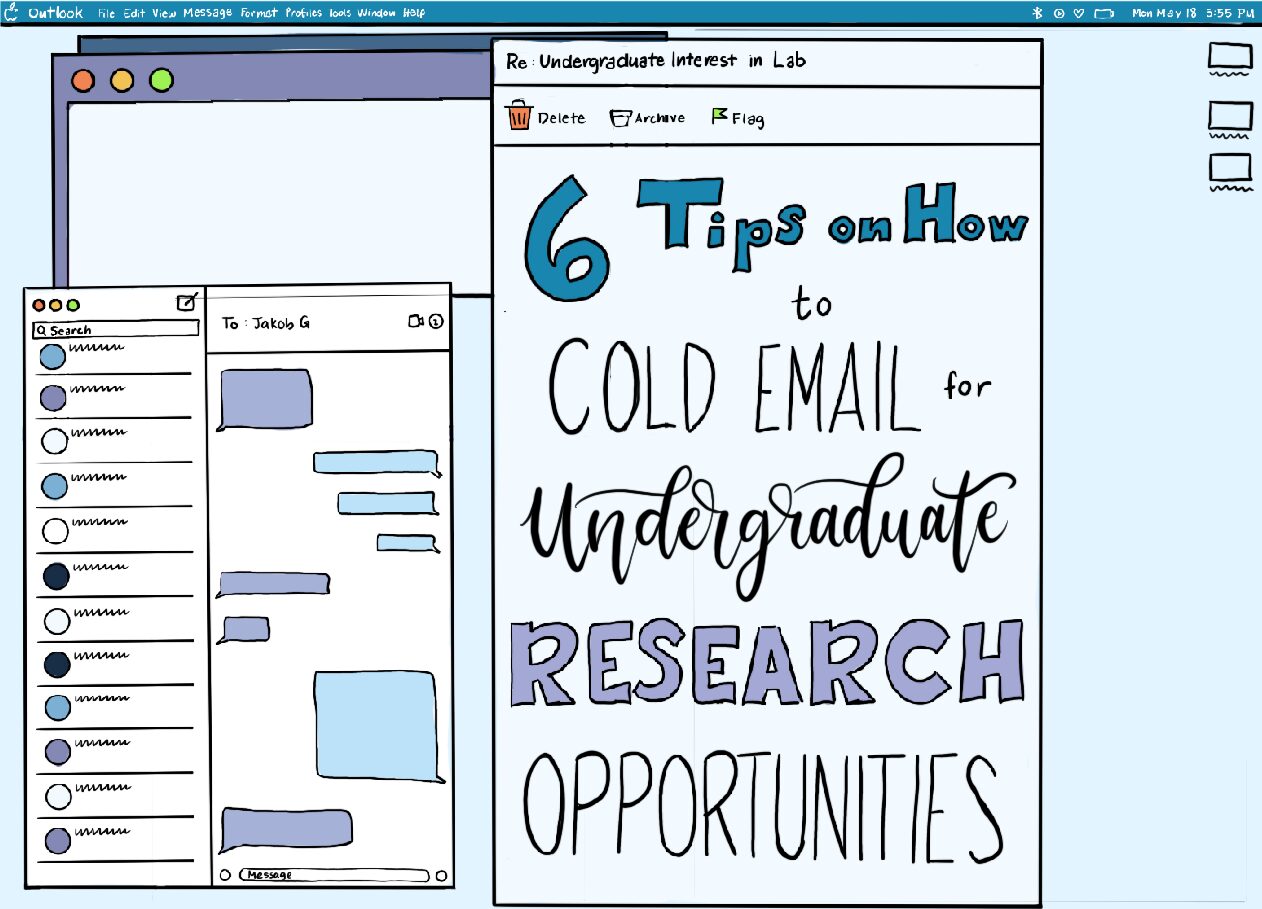
Cold Emailing for Undergrad Research: 6 Tips & Sample
When beginning to attend UNC I knew I wanted to pursue research, but what I didn’t know was how extensive the process would be. There are many different routes people take to get involved in research. Whether it’s through professors, summer programs, networking, or cold emailing. I found the most common way for undergraduates to become involved is through cold emailing, which is exactly how I found my position!
If you’re an undergraduate student looking for research opportunities, you’ll hear advice from everyone. In my second semester of my freshman year I finally landed a position in a lab. Here are a few things that I found to be helpful on my hunt for a position as an undergraduate research assistant!
1. Start Early
If there’s a certain semester you plan to get involved in research, I would recommend starting to email the semester or summer before. In my experience, I wanted to get involved my first semester at UNC, however, things didn’t really go that way. There’s a huge buffer time between when you start cold emailing and when you get a position. You want to make sure to account for that time. I would suggest giving yourself at least ~2 months to find a lab, although you can start earlier if you would like!
2. Stay Organized and Do Your Research
If you’re interested in a certain subject I suggest making a list of at least 20 private investigators (PIs) you would like to email. On your list I would take note of the PI’s name, their email, the focus of the lab, status of your email (“need to send”, “sent”), and any notes about their lab, such as whether they’re undergraduate-friendly.
I found that making the list made the process a lot smoother, so instead of having to research what labs I wanted to contact in between each email I already knew who I was going to email next. Additionally, when you do background research on the lab you can see if the lab is undergraduate-friendly or not. In my experience, if labs tend to have a lot of undergraduates, it’s unlikely they’ll offer you a position, but if there’s only a few undergraduates and if one of them is a graduating senior, there’s a higher change of you joining the lab.
3. Personalize Your Email
This is a tip that I received directly from one of the PI’s that I chatted with. She said that she appreciated how my email showed that I looked into the research focus of the lab, and even included a few details from papers that they published.
When drafting your email, you don’t want your email to seem generic, PI’s will be able to tell if an email was copy and pasted to many other PI’s. Prior to writing my emails I made sure to skim 1-2 papers that the lab has published so I could include some of that knowledge. You don’t need to read the whole paper, as they can get quite long, but I read the abstract, some of the results, and discussion.
When writing my email I would write how I found a specific point interesting, or I would ask them questions specific to a paper that I read. By including details such as these, it shows the PI that you genuinely care about their research.
4. Send Follow Up Emails
PI’s always get a lot of emails, so sometimes you’re email can get lost in the flood of their inbox. Following up after 10 days allows for your email to be seen again, and it lets the PI know that you have a continued interest in their lab. When talking to the same PI I mentioned earlier, this was also a point that she said she appreciated.
5. Keep the Email Short
Going off the follow-up email point, because PI’s have a lot of emails, you want to keep your email short and sweet. I would say my emails were typically 2 short paragraphs in length. In the first paragraph you can introduce yourself, while the second paragraph would include points referencing the lab’s research. Make sure you end with a “thank you” of some sort!
6. Don’t Send Your Emails All at Once
This process will require you to send A LOT of emails, and it can get tiring really quick. Each email takes a while, especially since you have to do a little research before hand. I would recommend sending 1-2 emails a day, and not all at once. By doing this, you won’t get burnt out, and your emails will be consistent in quality.
Sample Email
Here’s a copy of the email that I sent to the PI who I’m now assisting that you can use for reference:
Dear Dr. Tamir,
Good afternoon, I am currently a freshman at UNC Chapel Hill majoring in B.S Biology with a minor in chemistry, and I am especially interested in your research in signaling processes.
The topic of your research is something that I always felt very interested in when learning about in biology, and I love seeing how what I’ve learned in my classes is used in real life. Oncology is also another field that I find interesting, so I find your project regarding signaling and resistance to cancer therapy fascinating. I’ve never considered the possibility of treating the resistance aspect when it comes to cancer treatment. I would love to learn more about this, as well as the pathways involved in oxidative stress, as that is something I’m not too familiar with.
I’m currently on break and not at UNC, however, I would love to meet over Zoom! Please let me know if you would be open to this idea.
Thank you so much for taking the time to read this email, and I’m looking forward to hearing from you soon!
Best regards,
Jacqueline M
These are just a few things that I picked up along the way when attempting to get an undergraduate research assistant position. Don’t be discouraged from the first few rejections, or when a PI ghosts you. It’s something that everyone experiences when cold emailing. I hope these tips helped you out!
Good luck,
Jacqueline